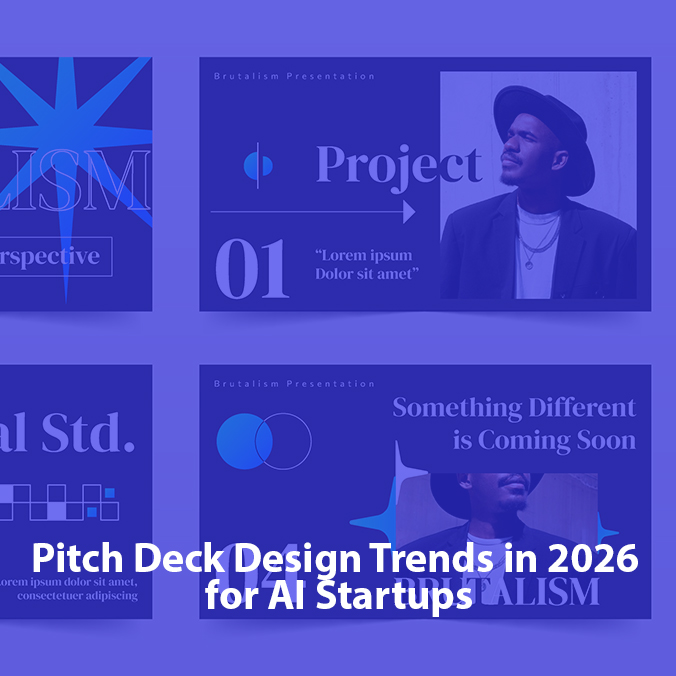
Securing venture capital has changed dramatically because of the constant shifts within the AI industry. Global artificial intelligence startup funding has reached a staggering $258.7 billion, requiring unique ideas to catch the attention of VCs and angel investors. Adopting pitch deck design trends for 2026 can help your project to stand out as venture capital partners are constantly flooded with top AI proposals every single week.
Let us look at exactly how you can transform your layout, structure your complex technical architectures, and design an elite presentation that commands the attention of leading global investment firms.
Why a Pitch Deck Matters Specifically for AI Startups
For an artificial intelligence company, an investment presentation is not a decorative accessory. It is a critical piece of technical communication designed to establish immediate market credibility because venture capital partners are exhausted by basic software wrappers.
- Architectural Proof: Proves your business idea is defensible and a proprietary data loop rather than a simple third-party API connection.
- Simplifying Complexity: Translates intricate machine learning pipelines and highly complex deep tech engineering into clean, intuitive pitch deck layouts.
- Visualizing Autonomy: Demonstrates your specific levels of agentic autonomy, showing exactly how digital workers execute tasks without human intervention.
- Eliminating Model Dependency: Illustrates that your long-term value lies in custom fine-tuning and unique datasets rather than general foundation models.
- Accelerating Investor Review: Optimizes objectives and design for immediate visual scanning, passing both human and automated algorithmic filters.
Five Simplified Design Trends Dominating the Industry
To win seed or Series A capital today, your visual narrative must reflect the cutting-edge nature of your technology. Based on a deep analysis of twenty-five heavily funded startups that collectively raised over $100 million recently, five dominant presentation methodologies are reshaping investor standards.
1. Autonomous Agent Workflow Diagrams
Presentations have shifted from displaying human-centric product dashboards to mapping out autonomous agency. Funded presentations now feature specialized system architecture diagrams that clearly illustrate what specific work is being executed independently by digital employees rather than human workers. Instead of showing standard software screenshots, slides utilize clean node-based flowcharts to visualize how an agent receives an input, processes the decision matrix, and executes actions across enterprise tools. This layout choice immediately proves a measurable reduction in human dependency on the reviewing partner.
2. Bottom-Up Pricing Tables
The traditional total addressable market slide featuring massive, nested circles is completely obsolete. Forward-thinking companies use crisp data visualization layouts to showcase bottom-up monetization math tied directly to their initial ideal customer profile. The design movement favors highly structured pricing matrices and financial unit economic tables that visually break down how the startup captures an immediate economic wedge. This demonstrates a clear path to profitability and rapid customer expansion without relying on vague industry generalizations.
3. Data Loop Moat Infographics
Investors pass on startups that cannot prove long-term defensibility. A major strategy within pitch deck design trends in 2026 is the inclusion of a dedicated, custom infographic detailing your proprietary data loop. This infographic slide uses sharp, cyclical vector graphics to show how user interaction feeds your custom models, which subsequently optimize product performance and create a self-reinforcing barrier against massive tech incumbents. Visually detailing this proprietary data asset kills the wrapper objection instantly and builds immense confidence.
4. Minimalist Design with Massive Stats
With investors increasingly reviewing proposals on mobile devices while traveling, dense blocks of text have been replaced by extreme typographic hierarchy. The winning aesthetic relies on deep charcoal or stark white backgrounds paired with a single, high-contrast accent color like electric green or vibrant amber. Key metrics such as annualized revenue run rate, customer retention cohorts, or validation proof points are styled in massive, bold typography to anchor the slide, ensuring the core takeaway is impossible to miss during a quick three-second scan.
5. AI-Scannable Document Layouts
Because venture funds frequently plug incoming files into parsing models before human review, the technical formatting of your document is a vital element of its structural design. Modern layouts utilize clean, selectable vector text and structured layouts that machine algorithms can easily parse semantically. Complex charts are paired with direct, plain-text headline summaries written as definitive conclusions rather than generic topic labels, enabling both human partners and screening models to instantly score the presentation.
Why Choose Professional Pitch Deck Designers
Attempting to build an investment presentation using basic, automated template generators is a massive business risk. While automated platforms can structure basic layouts quickly, they ultimately produce generic, uninspired slides that lack human nuance and brand identity, signaling a lack of genuine effort to a venture capital partner.
- Fixes Broken Data Formatting: Designers ensure your charts use clean vector elements with selectable text, stopping automated venture capital parsing algorithms from misreading or rejecting your metrics.
- Erases the GenAI Template Look: Studio experts build completely bespoke interfaces from scratch, instantly signaling to an investor that you spent serious capital and effort on your presentation rather than relying on rapid AI slop generators.
- Eliminates Financial to Narrative Disconnect: Professionals perfectly synchronize your financial projection models with your visual timeline, ensuring a milestone mentioned on slide three matches the capital distribution table on slide twelve down to the dollar.
- Translates Code Architecture into Graphics: Specialized designers take abstract machine learning code pipelines and transform them into intuitive node diagrams, saving you from using confusing, low-resolution software screenshots.
- Bypasses Mobile Layout Corruption: Experts optimize every slide container for cross-device viewports, ensuring your text layouts and key performance charts do not distort when an investor reviews your PDF on a smartphone screen.
Conclusion
The fundraising phase has evolved past the point of speculative hype. If you are hiding behind ambiguous technological jargon or relying on generic, cookie-cutter slide designs, investors will reject your pitch in the first ten seconds. Winning the capital markets requires absolute clarity, definitive proof of autonomy, and a striking visual identity that reflects true engineering authority.
To ensure your startup stands out in this highly competitive landscape, you need a custom-built, expert presentation strategy. Curate9 follows the top pitch deck design trends for 2026 to capture investor interest and position you for success. Contact us today!
Frequently Asked Questions
What are the top pitch deck design trends in 2026 for AI startups?
The top pitch deck design trends in 2026 for AI startups focus on layouts that illustrate autonomous agent workflows, bottom-up monetization tables replacing vague market maps, clear infographics demonstrating a proprietary data loop, and high-contrast minimalist typography optimized for fast mobile viewing.
How many slides should an artificial intelligence investor presentation contain?
An elite presentation should ideally consist of 10 to 16 highly focused slides. Every single slide must perform a specific strategic job, such as proving traction or detailing product defensibility, and any element that fails to accelerate investor conviction should be removed entirely.
Can I use basic automated presentation tools to build my fundraising deck?
Relying solely on automated design tools is highly discouraged for serious fundraising rounds. Automated systems frequently create generic layouts that fail to capture the unique human story, competitive moats, and technical nuances of your business, making your startup look undistinguished to top-tier investors.